
Why Professional Real Estate Photography Matters for a Listing
Almost every buyer sees the apartment on a phone before they see it in person, which National Association of Realtors research on how buyers search online has documented for years. That’s the entire argument for professional listing photography, and it doesn’t need any inflation beyond that.
What photography can’t do is fix a price, hide a condition problem, or invent a view. What it can do is make the property legible, so the people who show up are the ones who already understood what they were coming to see.
Good photos answer questions instead of just looking nice
A listing photo has a job: tell someone what the room is, how big it is, where the light comes from, and how it connects to the rest of the apartment.
A complete set usually covers the main living space from an angle that explains the layout, the kitchen, the bedrooms, every bathroom, storage worth mentioning, outdoor space, the view if there is one, and whatever architectural detail is actually a selling point. Not every room needs three frames. Every significant space needs one that works.
The number depends on the property. A studio doesn’t need what a townhouse needs.
Honest beats flattering
There’s a version of real estate photography that oversells: extreme wide angles, aggressive editing, a lens that turns a nine-foot bedroom into something it isn’t. It generates showings, and then it generates disappointed buyers who feel misled standing in the doorway.
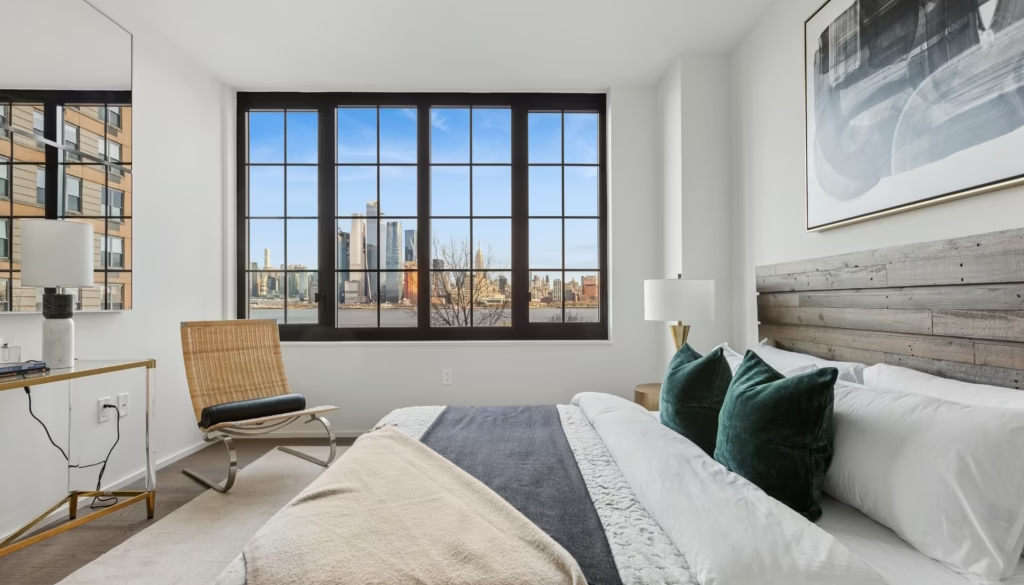
Controlled verticals, natural color, and a sensible focal length produce a listing that looks polished and holds up in person. The photo should be the best true version of the room. Nothing past that.
What it actually buys an agent
Time, mostly. Shooting, editing, and organizing a listing is half a day that an agent doesn’t have during a launch week.
But there’s a second thing that’s less obvious. Agents who treat photography as a real step, who send prep notes, who confirm building access ahead of time, who flag the features worth shooting, end up with better listings than agents who treat it as a box to check. The photography is the same. The preparation isn’t.
The agents who do this well have usually had the conversation with the seller before anyone shows up with a camera. That conversation is uncomfortable exactly once and pays off on every listing after.
The photos outlive the MLS post
Listing images end up on the brokerage site, in the email blast, on Instagram, in the brochure, in paid ads, and in the listing presentation for the next seller who asks what you’d do with their apartment. They need to work as a set, not as twenty unrelated pictures that happen to share an address.
Different assets solve different problems:
- Photography shows the condition, light, and character of the space.
- A floor plan explains layout and circulation, which no photo does well.
- Virtual staging gives an empty room scale and a sense of how furniture would sit.
Most listings need the first two. The third depends on whether the place is vacant and hard to read.
Preparation is still most of it
A photographer can work with a difficult apartment. A photographer cannot un-clutter a counter that’s still cluttered when the appointment ends.
The prep is unglamorous and the return is enormous: clear surfaces, working matched bulbs, made beds, open blinds, no cars in the driveway. See the preparation guide for the full version, which is written to forward to a seller as-is.
What photography isn’t
It’s one input. It won’t rescue a listing that’s priced past what the market will do, and it won’t paper over deferred maintenance that a buyer will find in the first ninety seconds. Good images plus an accurate description plus a realistic price is the combination that works. Any one of those alone is just marketing.
Hudson Heights RES shoots real estate photography, floor plans, and virtual staging across New York City and the nearby metro area, with standard next-business-day delivery. Packages and pricing, or talk to us about a shoot. Questions about a specific property are welcome. talk to us about a shoot.
NAR’s generational trends report adds useful context on how different buyer age groups search.
Related reading: what actually makes a listing photo work, How Photography Helps Agents Present Listings, and how wide shots and detail shots split the work.
Chris Leary is the founder of Hudson Heights RES, which photographs listings across New York City and the nearby metro area.
Chris Leary is the founder of Hudson Heights RES, which photographs listings across New York City and the nearby metro area.